

The holidays are the season of giving; unfortunately, it’s also the season when scammers try to cash in on the spirit of generosity
If you’re seeing a heartfelt charity ad on social media, a touching email, or a surprise text asking you to donate, it’s worth pausing for a moment. Is it genuine charity—or a scam built to tug at your heartstrings?
The good news: staying safe doesn’t mean stopping your generosity. With a few quick checks, you can give confidently and protect yourself.
What is charity fraud?
Charity fraud is when scammers pose as legitimate nonprofits—or misuse the name of a real charity—to trick people into donating money or giving away personal information.
In some cases, the organization is completely fake. In others, it’s a real charity that uses donations in misleading or unethical ways, passing very little money to the actual cause.
Type 1: Fully fake charities
The first type involves flat-out fraud, where the organization is a front for a scam, through and through. Any money you give goes straight into the scammer’s pocket. As does your personal and payment info, which can lead to further fraud.
Type 2: Low impact “charities”
These are real, registered charities. But They keep the majority of donations for overhead instead of helping the cause.
This second type often involves questionable practices by the organization. According to the Better Business Bureau, reputable organizations keep 35% or less of their funds for operations.
Meanwhile, some less-than-reputable organizations keep up to 95% of funds, leaving only 5% for advancing the cause they advocate. (For a closer look at some examples, the independent watchdog group Charity Watch published a blog highlighting some of the worst charities they audited in 2024.)
Common to both, they’ll indeed play on your emotions, and they’ll urge you to donate now. As it is with so many scams and shady deals on the internet, you’ll find a sense of urgency central to their message.
How to spot a charity scam
1. Look for a dot-org domain
For starters, reputable charities often have dot-org as their domain extension—versus dot-com or any one of the hundreds of permutations available today.
2. Research the organization
Charities leave a paper trail, one that can get audited. And fake ones won’t leave a trail at all. With a quick look at some reputable online resources, you can quickly find out if the charity you want to support is legit.
In the U.S., the Federal Trade Commission (FTC) has a site full of resources so that you can make your donation truly count. Resources like Charity Watch and Charity Navigator, along with the BBB’s Wise Giving Alliance can also help you identify the best charities. You can also look up a charity’s Form 990 tax return online.
3. Take your time
This goes hand-in-hand with the above. If you feel like you’re getting rushed to donate, it could be a sign of a scam. Step back and indeed do your research with a few clicks to the resources listed above.
4. Pay with a credit card
This protects you in two ways. If you fall victim to a scam, you can contest the charges with your credit card company. And if a scammer tries to use your card again for other purchases, you can contest those too. Also, in the U.S., credit cards offer you additional protection that debit cards don’t. That’s thanks to the Fair Credit Billing Act (FCBA). It limits your liability to $50 for fraudulent charges on a credit card if you report the loss to your issuer within 60 days.
5. Avoid sketchy payment methods
The following is a sure-fire red flag: requests for payment in cash, gift cards, cryptocurrency, or wire transfers. Don’t ever use these forms of payment for charities, let alone anything else online.
6. Donate directly
Better yet, donate directly. Rather than respond to calls, ads, emails or texts, donate on your terms. After you give your possible donation some time and thought, you can go directly to the website of a charitable organization that you’ve researched.
And here’s how McAfee can help you stay safer still.
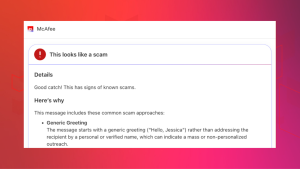
Get a scam detector. You can combine your healthy skepticism and awareness with the right technology, like our Scam Detector and Web Protection.
Both will alert you if a link you received might take you to a sketchy site. It’ll also block those sites if you accidentally tap or click on a bad link.
Clean up your personal info online. Scams over email, phone, and text all require the same thing: your contact info.
In many cases, scammers get it from data broker sites. Data brokers buy, collect, and sell detailed personal info, which they compile from several public and private sources, such as local, state, and federal records, plus third parties like supermarket shopper’s cards and mobile apps that share and sell user data.
Moreover, they’ll sell it to anyone who pays for it, including people who’ll use that info for scams. You can help reduce those scam texts and calls by removing your info from those sites. Our Personal Data Cleanup scans some of the riskiest data broker sites and shows you which ones are selling your personal info.
Monitor your identity and credit. The problem with many scams is that you only find out about it once the damage is done, like when a scammer uses your phished card number to make additional purchases in your name.
Actively monitoring your identity and credit can spot a problem before it becomes an even bigger one. You can take care of both easily with our credit monitoring and identity monitoring.
Additionally, our identity theft coverage can help if the unexpected happens with up to $2 million in identity theft coverage and identity restoration support if determined you’re a victim of identity theft.
You’ll find these protections, and plenty more, in McAfee+.
A safe way to support the fight against cybercrime
If you want to give back and help protect people from online fraud, McAfee has partnered with Fight Cyber Crime, a legitimate U.S. nonprofit dedicated to helping victims of online scams.
You might remember them from our Scam Stories partnership earlier this year, sharing real stories from real scam victims to raise awareness about threats facing us every day on and offline.
Why we recommend them
- They provide free support and recovery guidance to scam victims.
- They raise nationwide awareness about cybercrime.
- They’re a vetted, established organization doing real work in online safety.
How you can help
Visit their site to learn more or make a donation: https://fightcybercrime.org/about/donate/
Supporting validated charities like Fight Cyber Crime is one way to make a real impact this holiday season—without putting yourself at risk.

Stay Updated
Follow us to stay updated on all things McAfee and on top of the latest consumer and mobile security threats.